TL;DR
- An NRI can verify Indian property title remotely: pull the Encumbrance Certificate (EC), RTC/ROR (land record), mutation/khata history and the chain of registered deeds from state portals, run CERSAI and eCourts/NCLT searches, and commission a source-backed, lawyer-reviewed Title Search Report (TSR) — no flight required.
- The single most important guardrail: if you must use a Power of Attorney, use a registered, current, Specific POA for that exact transaction, and independently confirm the grantor is the recorded owner before any money moves.
- Most diligence inputs are already online and lawful to access; what cannot be done remotely is a physical possession check and original-document inspection — budget for a local agent and a lawyer for those.
- Never wire funds against scans alone. Verify the title chain, encumbrances and litigation first, then release money in tranches tied to verified registration.
- Treat this as a workflow, not a one-off check: the same pillars (Ownership, Land, Encumbrance, Litigation) apply whether you are in Dubai, London, or Singapore.
How can an NRI verify property title in India remotely without flying back?
You verify it the same way an onshore buyer should: by reconstructing the title chain and stress-testing it against government records — almost all of which are now online. An NRI sitting abroad can lawfully access the Encumbrance Certificate, the current land record (RTC/Pahani in Karnataka, or the equivalent Record of Rights elsewhere), mutation and khata entries, and the full set of registered deeds for a property. You layer on a central mortgage search (CERSAI) and a litigation search (eCourts, the relevant State High Court, and NCLT if a company owns the land). Then a lawyer reads the whole set, flags defects, and signs a Title Search Report.
The remote-friendly part is data gathering. The part that still needs boots on the ground is physical verification — who actually occupies the land, whether boundaries match the survey sketch, and whether the originals exist. The good news: you can run the entire records workflow yourself or have it run for you, and only deploy a local person for the narrow physical checks.
The honest answer-first version
- What you can do entirely remotely: EC, land record, mutation/khata, deed chain, encumbrance search, litigation search, AI-assisted translation of vernacular records, and a lawyer-reviewed TSR.
- What needs someone physically there: site possession check, boundary/measurement, neighbour enquiry, and inspection of original title documents in the seller's custody.
- What protects your money: never paying before the title chain, encumbrances and litigation are verified, and using a tightly-scoped registered POA if you cannot sign in person.
What documents and records should an NRI pull — and from where?
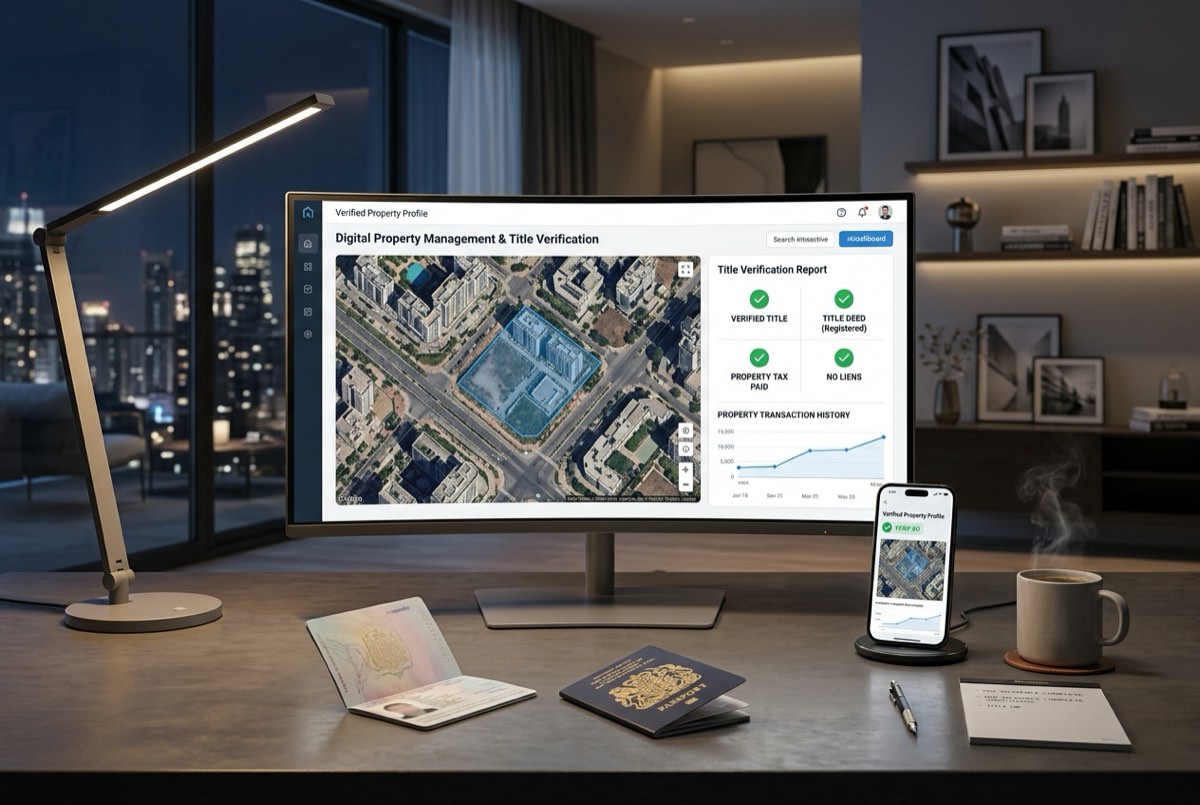
Pull the records below in this order. Each is accessible online (some need an OTP-verified account), and together they let a lawyer reconstruct ownership and spot defects. The table is Karnataka-specific where deep portals exist, with the pan-India equivalent named so the approach transfers to any state.
| Record | What it proves | Karnataka portal | Pan-India equivalent |
|---|---|---|---|
| Encumbrance Certificate (EC) | Registered transactions and charges over a period (the "transaction ledger") | Kaveri 2.0 | State registration dept portal / sub-registrar |
| RTC / Pahani (land record) | Current recorded holder, extent, land use, crop, Col. 11 charges (agri/converted land) | Bhoomi | Record of Rights / 7-12 / Jamabandi / Patta-Chitta |
| Mutation register (MR) | History of how ownership changed hands in revenue records | Bhoomi | State revenue mutation records |
| Khata / property tax record | Municipal recognition for tax (not title) — now mostly e-Khata | BBMP e-Aasthi (urban) / e-Swathu (panchayat) | Municipal khata / property tax portal |
| Registered deeds (sale, gift, partition, etc.) | The actual chain of title transfers | Kaveri 2.0 (certified copies) | Sub-registrar certified copies |
| Mortgage / charge search | Whether the asset secures a loan | CERSAI (central) | CERSAI (central, all states) |
| Litigation search | Pending suits, disputes, insolvency | eCourts, Karnataka HC, NCLT | eCourts, relevant State HC, NCLT |
A few practical notes for NRIs specifically:
- The EC is your first read, but it is not the whole story. It lists registered transactions. Unregistered arrangements, oral tenancies, family claims and many court orders will not appear. Read it alongside the deed chain. See how to pull and interpret it in our guide to Kaveri Online 2.0 ECs and certified deeds.
- The RTC/Pahani anchors agricultural and converted land. It shows the recorded holder and extent, and Column 11 captures loans and other charges noted in revenue records. Our Bhoomi RTC walkthrough covers what each column means.
- Khata proves tax liability, not ownership. A clean e-Khata is reassuring but never a substitute for the deed chain. Karnataka has been pushing e-Khata as effectively standard for fresh registrations, so its absence on a recent transaction is itself worth questioning.
- Vernacular records. Many Karnataka records are in Kannada. You can have them translated; a source-backed TSR keeps the original alongside the translation so nothing is lost in interpretation.
How far back should the title chain go?
For most buyers, reconstruct a 30-year chain of title from the registered deeds, cross-checked against mutation and EC entries, and align it with the Limitation Act's logic on adverse possession and stale claims. Thirty years is the conventional diligence window in India; some lenders accept a shorter verified chain, but 30 years is the safe default for an outright purchase.
How does an NRI run the searches without an Indian address or in-person visit?
Most portals are public-facing and only require an account with OTP verification, which works fine on an overseas number or email. Three things to plan for:
- Account access. Kaveri 2.0 requires a registered account for ECs and certified copies; the OTP-driven flow is doable from abroad. Bhoomi RTC and many municipal records are viewable without an account, though certified copies may need a small online payment.
- Payments. Certified copies and EC fees are modest and typically payable online. Court certified copies and some municipal documents may need an Indian payment method — a relative or your lawyer's office can handle these.
- The physical-verification gap. Appoint a trusted local agent or your lawyer's clerk to do a site visit: confirm possession, photograph boundaries, compare against the survey sketch (and K-GIS/spatial overlays where available), and ask neighbours. This is the one step that genuinely cannot be done from a laptop.
What about agricultural land — can an NRI even buy it?
This is a common confusion, and it has two separate layers. First, Karnataka has repealed Sections 79A and 79B of the Karnataka Land Reforms Act (the change that opened agricultural-land purchase to non-agriculturists), and that repeal remains in force — a restoration has been announced but, so far, not enacted into law. Second, and independently, RBI/FEMA rules restrict NRIs and OCIs from buying agricultural land, plantation property or farmhouses in India; the main route to holding such land is inheritance. So a non-agriculturist resident may be able to buy farmland in Karnataka while an NRI generally cannot. If your target is agricultural or converted land, get FEMA advice before anything else — this is a threshold question your lawyer must clear.
What can these records and portals NOT tell you?
A great deal — which is exactly why the lawyer-review step is non-negotiable. Remote records have hard limits:
- Possession. No portal shows who is physically on the land today. Encroachment, a tenant, or a relative in occupation will not appear in an EC or RTC.
- Unregistered claims. Oral agreements, unregistered POAs, family settlements, and many older partitions leave no registered trace.
- Fraud and impersonation. Records can be forged or a fraudster can pose as the owner. Confirming the grantor is the recorded holder — and that any POA is genuine, registered and unrevoked — is the single biggest NRI-specific risk. Many of these traps are catalogued in our piece on common title defects in Indian real estate.
- Government acquisition and zoning. Notifications for road-widening, acquisition, or zoning changes may not surface in standard searches without checking the relevant planning authority.
- Currency and lag. Portals lag reality. A registration done last week may not yet reflect in the EC; a court case filed yesterday may not be indexed.
This is the heart of Deedwise's model and the right framing for any remote buyer: AI gathers the records and drafts the analysis at speed; a qualified lawyer reviews the evidence and signs the report. The automation removes the grunt work; it does not remove the professional judgement.
How should an NRI use a Power of Attorney safely?
Use a Specific (Special) POA, registered, current, and narrowly scoped to the exact transaction — never a broad General POA handed to someone you cannot supervise. The POA is where remote NRIs are most often defrauded, so treat it with more caution than any other document.
| POA factor | Safe practice | Red flag |
|---|---|---|
| Scope | Specific to this property and these acts (e.g. execute sale deed for one identified survey number) | "General" POA covering all your affairs |
| Registration | Executed and registered properly (and adjudicated/attested at the Indian mission, then stamped in India as required) | Notarised-only, or never registered |
| Currency | Recently dated; confirm it is not revoked before relying on it | Years-old POA of uncertain status |
| Holder | A trusted, accountable person; ideally not the seller's side | Seller, broker, or seller's associate holding your POA |
| Verification | Counterparty/lawyer independently confirms grantor is the recorded owner | Acting on the POA holder's word alone |
If a seller is themselves transacting via POA, scrutinise it the same way — a defective or revoked POA in the chain can unravel title years later.
What does the end-to-end remote workflow look like, and what does it cost and take?
The sequence is: (1) confirm FEMA eligibility for the property type; (2) pull EC, land record, mutation, khata and the deed chain; (3) run CERSAI and litigation searches; (4) commission a local site/possession check; (5) get a lawyer to review everything and issue a signed TSR; (6) only then negotiate payment, structured in tranches against verified registration.
On cost and time: a source-backed remote TSR for a single property is usually a modest professional fee plus small per-record charges — far cheaper than a flight and a defective purchase. Exact figures depend on the property and scope; see our indicative ranges in the title search cost guide and realistic timelines in the turnaround-time guide. The records portion is fast online; the lawyer review and physical check are what set the calendar.
Frequently asked questions
Can an NRI verify property title in India without travelling?
Yes. The Encumbrance Certificate, land record (RTC/ROR), mutation/khata history and registered deeds can be pulled from state portals (Kaveri 2.0, Bhoomi and equivalents) entirely online, and CERSAI and eCourts/NCLT searches are remote too. A lawyer can review the full record set and issue a signed Title Search Report without you flying back. The only step that genuinely needs a person on the ground is the physical possession and boundary check.
Can an NRI or OCI buy agricultural land in India remotely?
Generally no. Independent of state land-reform rules, RBI/FEMA restricts NRIs and OCIs from acquiring agricultural land, plantation property or farmhouses, with inheritance being the main route to holding such land. Note that Karnataka's repeal of Sections 79A and 79B (which let resident non-agriculturists buy farmland) does not override these FEMA restrictions. Always clear FEMA eligibility for the property type before starting diligence.
What is the safest type of Power of Attorney for an NRI buyer?
A Specific (Special) Power of Attorney that is properly registered, recently dated, and narrowly scoped to the exact transaction — for example, executing the sale deed for one identified property. Avoid broad General POAs, never hand your POA to the seller's side, and have your lawyer independently confirm the grantor is the recorded owner and that the POA is unrevoked before any money moves.
Does an Encumbrance Certificate or clean Khata mean the title is clear?
No. An EC only lists registered transactions and charges; unregistered claims, oral tenancies, family disputes and many court orders will not appear. A Khata proves municipal tax recognition, not ownership. Clear title is established by reconstructing the registered deed chain (typically 30 years) and cross-checking it against mutation, EC, mortgage and litigation searches — then having a lawyer assess it.
How can an NRI avoid being defrauded when buying remotely?
Verify before you pay. Confirm the seller (or POA holder) is the recorded owner across the EC, land record and deed chain; run a CERSAI mortgage search and a litigation search; commission an independent local site and possession check; and use only a registered, current, Specific POA. Release funds in tranches tied to verified registration rather than wiring a lump sum against scans.
What can remote records never reveal about a property?
Physical possession and encroachment, unregistered claims and oral arrangements, impersonation or forged documents, pending government acquisition or zoning notifications not yet indexed, and very recent changes that portals have not caught up with. These gaps are why a source-backed records pull must always be paired with a physical check and a lawyer's signed review rather than relied on alone.
Continue reading


Automate your due diligence
Skip the manual portal work.
Deedwise automates everything in this article — across every connected portal — and delivers a complete Title Search Report in hours.
Request Access